
Welcome to my research space, where I bridge the gap between fragmented data and meaningful AI by ethically distilling the world’s digital chaos into responsible knowledge that empowers more intuitive, human-centered intelligent systems.

Mario Lezoche
Knowledge, Cognition, and Human-Centric Artificial Intelligence
I am Associate Professor (Maître de Conférences HDR) in Computer Science at Université de Lorraine, researcher at CRAN (CNRS UMR 7039), working at the intersection of artificial intelligence, knowledge engineering, and complex socio-technical systems.
My work explores a fundamental question:
How can knowledge be formalised, understood, and transformed into intelligent systems that remain aligned with human reasoning and values?
A Research Vision: NOESIS
My research is structured around the concept of NOESIS, understood as the act of intellectual understanding through which intelligence apprehends truth.
NOESIS is both a philosophical foundation and a scientific framework. It articulates six complementary principles that describe the emergence of knowledge:

Nous
Intuitive intelligence that perceives underlying structures


Sophia
Ethical understanding guiding knowledge and responsibility


Aletheia
The unveiling of hidden structures within data and systems


Prajna
Enlightened knowledge enabling reasoning and decision

Sangha
Collective intelligence emerging through collaboration


Agora
The space where knowledge is shared, debated, and applied

At the center of these principles lies empathy, ensuring that knowledge remains human-oriented, interpretable, and meaningful.
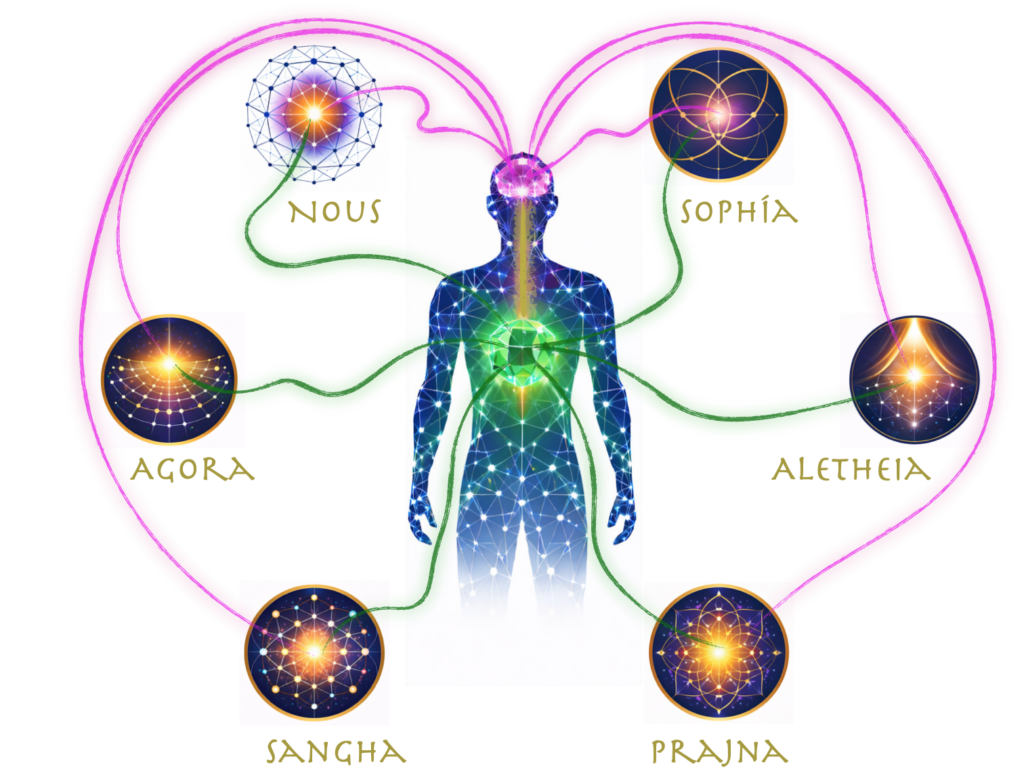
This vision can be expressed as a progression:
Knowledge → Understanding → Empathy → Action
It reflects the ambition to design systems that do not merely compute, but interpret, explain, and support human decision-making.
Scientific Trajectory and Research Axes
My research trajectory, formalised through my HDR and developed in national and international projects, is structured around three interrelated axes.
1 – Knowledge Formalisation and Semantic Interoperability
I develop formal approaches to structure heterogeneous knowledge through:
• ontology engineering and semantic web technologies
• formal concept analysis and relational concept analysis
• knowledge graphs and reasoning frameworks
These methods aim to ensure interoperability, traceability, and explainability in complex systems.
2 – Knowledge Extraction from Complex Data
Modern systems generate large volumes of heterogeneous and often fragmented data. A central challenge is to reveal the underlying structures that transform data into knowledge.
My work focuses on:
• extracting structured knowledge from heterogeneous sources
• integrating expert knowledge with data-driven approaches
• enabling semantic interpretation of complex environments
This corresponds to the principle of Aletheia, where knowledge is understood as a process of unveiling.
3 – Cognitive AI and Digital Twins
A key direction of my research is the development of knowledge-driven cognitive systems that integrate:
• symbolic reasoning (ontologies, formal models)
• subsymbolic approaches (machine learning, AI)
This leads to the concept of Cognitive Digital Twins, systems that combine data, models, and knowledge to support reasoning, simulation, and decision-making in complex environments.
As highlighted in my recent research and projects, these systems enable:
• explainable and traceable decision support
• simulation and exploration of alternative scenarios
• preservation and transmission of expert knowledge in industrial systems
Toward Human-Centric Artificial Intelligence
Contemporary artificial intelligence is largely driven by data and optimisation. While effective, such approaches often lack:
• explicit knowledge representation
• interpretability and transparency
• alignment with human reasoning
My research contributes to addressing these limitations through hybrid cognitive architectures, combining formal knowledge models and machine learning.
The objective is to develop human-centric, explainable, and resilient intelligent systems, aligned with the principles of Industry 5.0, where artificial intelligence augments human expertise rather than replaces it.